
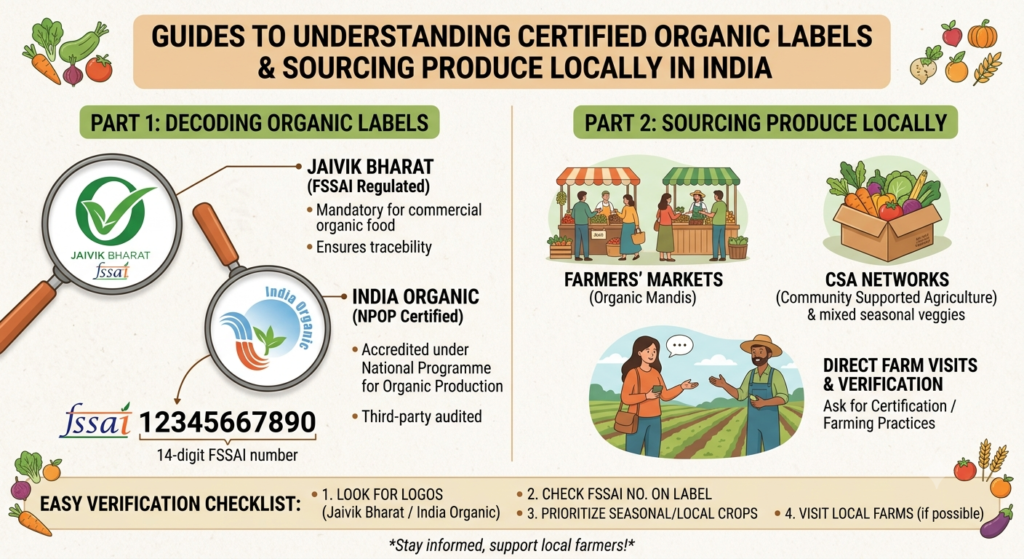
organic certification labels in India
Learn why Understanding certified organic labels in India is important and discover practical ways to source fresh, local produce from trusted farmers and markets.
Walking into a local sabzi market or scrolling through an online grocery app can leave anyone overwhelmed. Almost every brand claims its leafy greens are “100% natural,” “chemical-free,” or “purely organic.” But unless you know what to look for, paying a premium for these claims can feel like a gamble.
Bridging the gap between clever greenwashing and genuinely clean food comes down to understanding India’s official organic certifications and knowing how to connect directly with regional growers.
You do not need to become a food-science expert. A little awareness and a few practical checks can make grocery shopping much easier.
What Does “Organic” Actually Mean?
Organic farming generally focuses on growing crops through methods that support soil health, biodiversity, and more sustainable agricultural practices. Depending on the certification standard, organic production restricts or prohibits many synthetic chemical inputs, genetically modified organisms, and certain farming practices.
However, the word “organic” on a package should not automatically be treated as proof of certification. Different sellers may use terms loosely, which is why checking the details matters.Organic certification is designed to provide consumers with confidence that a farm or food business follows defined production and handling standards.
Understanding Organic Certification in India
India has official systems for identifying certified organic products. Two important certification frameworks consumers may come across are
1. National Programme for Organic Production (NPOP)
The National Programme for Organic Production (NPOP) operates under the Ministry of Commerce and Industry.
It provides standards for organic production, processing, handling, and certification. Products certified under this system may carry the relevant India Organic identification.
2. Participatory Guarantee System (PGS-India)
The PGS-India system is particularly relevant for small farmers and local farming communities.
Instead of relying only on conventional third-party certification, it involves a participatory process where farmers, local groups, and stakeholders assess whether farming practices meet organic standards.
This system can be especially useful when purchasing directly from small-scale growers or community-based organic farms.
External article-READ MORE—National Centre for Organic and Natural Farming
Organic, Natural, and Chemical-Free: Are They the Same?
This is one of the most common sources of confusion.
Organic farming
Usually refers to farming that follows recognized organic standards and, where applicable, has certification.
Natural Farming
Natural farming is an approach that emphasizes ecological processes and reduced external inputs. However, “natural” does not automatically mean officially certified organic.
Chemical-Free
This phrase can be misleading because everything—including water and plants—is made of chemicals. In everyday marketing, sellers often use it to mean “grown without synthetic pesticides,” but the claim may not have been independently verified.
Farm Fresh
Farm fresh generally describes freshness or a short supply chain. It does not necessarily mean organic.A vegetable can be locally grown and fresh without being certified organic—and that is perfectly fine as long as the seller describes it honestly.
Step-by-Step Checklist for Buying Organic in India
1.Check for the Jaivik Bharat Logo
Mandatory for commercial packaged goods
Look for the green circle, leaf, and tick symbol on the packaging. If a commercial brand claims “organic” without it, it does not meet FSSAI regulations.
2.Identify NPOP vs. PGS-India Marks
Know who verified the farm
Check whether it was verified by a third party (NPOP) or peer-reviewed by a local farming collective (PGS-India).
3.Look for the FSSAI License Number
Traceability verification
Locate the 14-digit FSSAI license number on the label to ensure food safety compliance.
4.prioritise Seasonal and Regional Crops
Avoid out-of-season produce
Genuine local organic farmers typically supply produce that aligns with the local climate and season rather than year-round uniform stock.
Does Certified Organic Mean Healthier?
Organic food is produced under specific farming standards, but it is important not to treat certification as a guarantee that a product is automatically more nutritious than every conventionally grown alternative.
The benefits of choosing organic may include supporting certain environmental practices, reducing exposure to some agricultural chemicals, and encouraging farming systems that prioritise soil and ecosystem health.
However, washing produce properly, eating a varied diet, and choosing fresh seasonal foods remain important regardless of whether the food is organic.
Organic certification is about production standards—not a promise that the food is a miracle health product.
Why Buying Local Produce in India Makes Sense
You do not always need to order expensive imported organic products to make better food choices.
India has a wide variety of local farmers, vegetable growers, cooperatives, self-help groups, and community markets. Buying locally can offer several advantages.
Fresher Produce
Locally sourced vegetables may spend less time in transportation and storage, especially when purchased directly from growers.
Support for Farmers
Purchasing from local producers helps keep more value within farming communities.
Better Understanding of Growing Practices
When buying directly, you may have an opportunity to ask how crops are grown, what inputs are used, and when the produce was harvested.
Seasonal Eating
Local markets naturally encourage seasonal eating, which can be more affordable and environmentally sensible.
Reduced Transportation Distance
Shorter supply chains may reduce transportation requirements, packaging, and unnecessary handling.
Where Can You Source Organic or Locally Grown Produce in India?
Depending on where you live, several options may be available.
1. Local Farmers’ Markets
Many cities and towns host weekly farmers’ markets or special organic bazaars. These are excellent places to meet growers and understand where your food comes from.
2. Farmer Producer organisations (FPOs)
FPOs bring farmers together to improve production, marketing, and market access. Some sell produce directly to consumers or through organised channels.
3. Community-Supported Agriculture
In some areas, consumers subscribe to receive seasonal produce directly from a farm or farming group.
4. Local Organic Stores
specialised stores may stock certified organic grains, pulses, spices, fruits, and vegetables. Ask about certification rather than relying only on the store’s branding.
5. Direct Farm Purchases
If you live near farming communities, buying directly from a trusted farm can be a rewarding option. Always confirm the farm’s practices and whether its products are certified or simply naturally grown.
6. Online Local-Farm Platforms
Some regional platforms connect consumers with farmers. Before ordering, check delivery details, product descriptions, certification claims, and customer reviews.
Questions to Ask a Local Seller
You do not need to interrogate a farmer—but a few friendly questions can help.
Try asking:
- Where is the produce grown?
- Is the farm certified organic?
- If certified, which certification system is used?
- What fertilizers or pest-control methods are used?
- Is the produce seasonal?
- How recently was it harvested?
- Is the product grown on your own farm or sourced from another supplier?
A genuine grower may not have every technical answer immediately, but transparency is usually a positive sign.
How to Identify Trustworthy Local Produce Sellers
A trustworthy seller generally provides clear and consistent information.
Look for:
- Honest descriptions of farming practices
- Clear pricing
- Information about the farm or source
- Willingness to answer reasonable questions
- Realistic claims rather than exaggerated promises
- Proper packaging and labeling for packaged goods
- Consistent quality over time
Remember: A small farmer without formal certification is not automatically dishonest, and a certified product is not automatically superior in every respect. Certification and trust both matter, but they serve different purposes.
Is Local Produce Always Organic?
No.
Local simply means the food is sourced from a nearby region or supply chain. A local farmer may use conventional methods, integrated pest management, natural farming, or certified organic practices.
The best approach is to distinguish between:
- Locally grown + certified organic
- Locally grown + naturally grown
- Locally grown + conventional farming
All three descriptions can be useful when they are accurate.The key is informed choice—not unrealistic perfection.
Practical Tips for Buying Organic Produce on a Budget
Organic products can sometimes cost more, but you can still shop thoughtfully.
Buy Seasonal Produce
Seasonal vegetables are often more affordable and fresher.
Purchase Directly from Farmers
Cutting out multiple intermediaries may reduce costs.
Buy in Moderate Quantities
Only purchase what your household can use before it spoils.
Focus on Staple Foods
If your budget is limited, consider prioritising products you consume frequently, such as pulses, grains, or commonly used vegetables.
Compare Sellers
Prices and farming practices can vary significantly between vendors.
Grow a Few Things Yourself
Even a balcony or kitchen garden can provide herbs such as mint, coriander, curry leaves, or basil.
How Consumers Can Encourage Better Farming Practices
Every purchase sends a small message to the market.
When consumers ask questions, support transparent farmers, reduce food waste, and value seasonal produce, they encourage better communication throughout the food supply chain.
- You can also:
- Carry reusable shopping bags
- Avoid unnecessary plastic packaging
- Reduce food waste
- Compost suitable kitchen scraps
- Support local growers consistently
- Share reliable information with friends and family
READ MORE–1.organic-gardening-for-beginners-easy-steps-to-thriving-garden
2.essential-guide-to-sustainable-living-green-harvest-guide
3.seasonal-indian-crop-calendar-what-to-plant-each-month-in-north-vs-south-india
Final Thoughts
Understanding organic labels and sourcing local produce in India does not have to be complicated. Start by learning the difference between certified organic, natural farming, chemical-free claims, and simply locally grown food.
Look for transparency, ask sensible questions, support trustworthy growers, and choose seasonal produce whenever possible.
Whether you buy from a neighborhood vegetable seller, a farmers’ market, or a certified organic store, informed decisions can benefit your household, local farming communities, and the environment.
And remember—sometimes the most sustainable grocery choice is not the fanciest package on the shelf. It is the fresh produce grown closer to home, purchased thoughtfully, and used without waste.
Frequently Asked Questions (FAQ)
1. What is the difference between organic and natural farming in India?
Organic farming follows recognized organic standards and may be certified. Natural farming is an ecological approach that may not always involve formal organic certification.
2. How can I verify an organic product in India?
PCheck the packaging for recognized certification information, producer details, and applicable organic labeling marks. You can also ask the seller for certification details.
3. Is locally grown food always organic?
No. Local produce may be organic, naturally grown, or conventionally farmed. Always ask about the farming method.
4. Is organic food more nutritious?
Organic certification relates mainly to production standards. Nutritional value varies by crop, freshness, variety, and handling—not simply by the word “organic.”
5. Where can I buy organic produce in India?
You can explore farmers’ markets, local organic stores, Farmer Producer organisations, community-supported farms, and reputable direct-to-consumer farm platforms.
6. Why should I buy seasonal vegetables?
Seasonal vegetables are often fresher, more affordable, and better suited to local growing conditions.
7. Are “chemical-free” vegetables genuinely chemical-free?
The phrase is often used informally and may not have a standardised meaning. Ask the seller what farming inputs were actually used.
8. Can I grow organic vegetables at home?
Yes. You can grow herbs, leafy greens, tomatoes, chillies, and several other crops using organic gardening methods in pots, containers, balconies, or small garden spaces.