
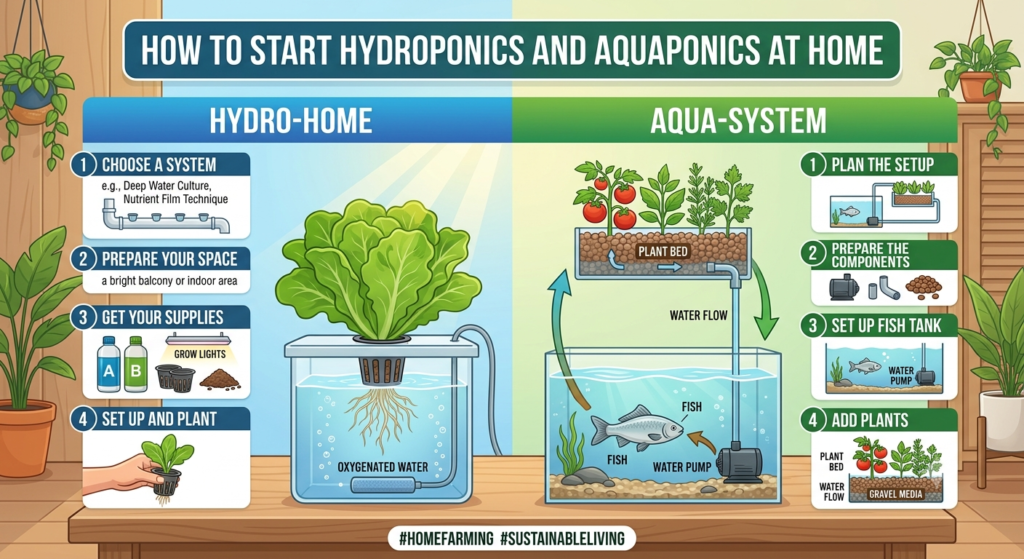
Have you ever wished you could grow fresh vegetables at home without needing a large garden? Maybe you have a balcony, terrace, or even a small indoor space, but traditional gardening feels difficult because of limited soil and space.
That is where hydroponics and aquaponics come in.
Both methods allow you to grow plants without relying on conventional soil beds. They can be particularly interesting for people living in Indian cities where balconies and terraces may be the only available gardening space.
But if you are a complete beginner, words like nutrient solution, pH, grow media, water circulation, and aquaculture can sound intimidating.
Don’t worry. You don’t need to build a high-tech farm on day one.
With a simple setup, some basic equipment, and a little patience, you can start learning how these systems work and gradually expand your home garden.
What Is Hydroponics?
Hydroponics is a method of growing plants without traditional soil.
Instead, plant roots receive water containing the nutrients they need for healthy growth.
Plants may be supported by materials such as coco coir, clay pebbles, perlite, or other inert growing media, depending on the system.
The basic idea is simple:
Roots + water + nutrients + oxygen + light = plant growth
Because plants don’t have to search through soil for nutrients, hydroponic systems can provide nutrients and water directly to the root zone.
Hydroponics can work especially well for leafy greens and herbs, making it an interesting option for beginners.
Beginner-friendly hydroponic crops
You can consider starting with:
- Lettuce
- Spinach
- Basil
- Mint
- Coriander
- Fenugreek
- Kale
- Pak choi
- Microgreens
- Some varieties of tomatoes and chillies with appropriate systems
For your first project, leafy greens and herbs are usually easier to manage than large fruiting plants.
What Is Aquaponics?
Aquaponics combines aquaculture and hydroponics.
In a typical aquaponic system, fish live in a tank. Their waste provides nutrients that can eventually be used by plants. Beneficial microorganisms help convert fish waste into forms of nitrogen that plants can use.
The plants absorb nutrients from the circulating water, helping clean the water before it returns to the fish tank.
In simplified form:
Fish → fish waste → beneficial bacteria → plant nutrients → plants → cleaner water → fish
It is a fascinating little ecosystem.
However, aquaponics is generally more complex than a small hydroponic system because you are caring for both plants and aquatic animals.
How to Start Hydroponics at Home in India
You don’t need a huge commercial setup.
A small balcony, terrace, kitchen window, or suitable indoor area can be enough for a beginner system, provided the plants receive appropriate light.
1. Choose the Right Location
Start by selecting a place where your plants can receive sufficient light.
For outdoor setups, protect the system from extreme heat, heavy rain, and strong winds.
This is particularly important in India because growing conditions can vary dramatically between regions.
A balcony in Delhi, a terrace in Punjab, a humid coastal city, and a cooler hill region will not have exactly the same requirements.
Observe your location before buying equipment.
2. Choose a Simple Hydroponic System
There are several types of hydroponic systems.
Deep Water Culture (DWC)
In DWC, plant roots are suspended in nutrient-rich water while air pump supplies oxygen.
This can be a relatively simple system for beginners.
Nutrient Film Technique (NFT)
NFT systems circulate a thin film of nutrient solution through channels containing plant roots.
These systems can be excellent for leafy greens but require reliable water circulation.
Kratky Method
The Kratky method is a passive approach that does not continuously circulate water.
Plants are placed above a nutrient solution, while the changing water level provides access to air as the roots develop.
For someone testing hydroponics for the first time, a small passive setup can be an inexpensive way to understand the basics.
Basic Hydroponic Equipments
Depending on the system, you may need:
- Growing containers or net pots
- Suitable growing media
- Nutrient solution
- Water reservoir
- Air pump and air stone for certain systems
- pH testing equipment
- Electrical conductivity (EC) meter
- Grow lights if natural light is insufficient
- Seeds or seedlings
- Tubing and water pump for circulating systems
Don’t buy everything at once.
Start small, learn how your plants respond, and upgrade your setup as you gain experience.
Understanding pH and Nutrients
This is one of the areas where beginners often feel overwhelmed.
Plants need nutrients in appropriate amounts, and nutrient availability is influenced by water chemistry, including pH.
A pH meter or test kit can therefore become a useful tool.
You should also use a nutrient product intended for hydroponic growing and follow the manufacturer’s mixing instructions rather than guessing the concentration.
Avoid assuming that more fertilizer means faster growth.
Too much nutrient concentration can damage plant roots.
Keeping records of your water, nutrient concentration, plant growth, and changes you make can help you understand your system.
How to Start Aquaponics at Home
Aquaponics requires more planning because the system contains fish as well as plants.
A basic setup normally includes:
- Fish tank
- Water pump
- Grow bed or plant channels
- Growing media
- Plumbing or tubing
- Aeration equipment
- Plants
- Fish
- Beneficial bacteria
The fish produce waste. Microorganisms process that waste, and plants use nutrients from the water.
But the system needs to become biologically established before it can function reliably.
This process is often called cycling.
For beginners, understanding the nitrogen cycle is one of the most important parts of learning aquaponics.
Choosing Fish for an Aquaponics System in India
Fish selection depends on your local climate, system size, water temperature, regulations, and the experience level of the grower.
Common aquaponics discussions may include species such as tilapia or carp, but suitability varies by location and setup.
Don’t choose fish simply because they are popular.
Before purchasing fish, check local rules and make sure the species is appropriate for your climate and system.
Most importantly, remember that fish are living animals, not simply a source of fertilizer. Water quality, oxygen, temperature, stocking density, and feeding all need proper attention.
What Plants Grow Well in Aquaponics?
Leafy greens and herbs are often suitable choices for beginners.
Consider:
- Lettuce
- Basil
- Mint
- Coriander
- Spinach
- Pak choi
- Kale
- Other leafy greens suited to your climate
Once you understand your system, you can experiment with larger plants.
However, larger fruiting plants generally have greater nutrient and structural requirements, so they may not be the easiest starting point.
Hydroponics and Aquaponics in India’s Climate
India’s climate creates both opportunities and challenges.
During hot summer weather, water temperature can become an important concern. Excessive heat can also stress plants and reduce dissolved oxygen in water.
During monsoon periods, outdoor systems may face heavy rain, humidity, pests, algae growth, and electrical safety concerns.
In winter, cooler temperatures can slow plant growth depending on your location.
A practical approach is to monitor your system rather than following a fixed calendar.
Check:
- Water temperature
- Plant condition
- Root health
- Water level
- pH
- Nutrient concentration where applicable
- Pump operation
- Algae growth
- Pest activity
A simple notebook can become your best gardening tool.
Pro Tips for Beating the Indian Heat
Keep Water Cool: When water temperatures exceed 30°C, dissolved oxygen levels drop, which can cause root rot. Keep water tanks shaded, wrap them with reflective insulation sheets, or place them indoors.
Use Shade Nets: Direct sunlight during Indian summers (April–June) can scorch leaves. Cover balcony setups with a 50% green shade net.
Invest in Backup Power: Submersible pumps rely on continuous power. During frequent power outages, use a basic inverter or solar-powered backup pump so roots don’t dry out.
Common Beginner Mistakes
Starting Too Big
A large system can look impressive online, but it also creates more opportunities for problems.Start with a small number of plants.
Overfeeding Plants
Adding extra nutrients doesn’t automatically produce healthier plants.
Follow the nutrient manufacturer’s instructions and monitor your plants.
Ignoring Oxygen
Roots need oxygen. Poor aeration or stagnant water can create root problems in many hydroponic and aquaponic systems
Choosing Too Many Plants
Every plant has different requirements.Start with one or two easy crops before experimenting with everything at once.
Forgetting Maintenance
Hydroponics isn’t completely maintenance-free.
Pumps need checking, water levels need monitoring, containers need cleaning, and plants still need attention.
Aquaponics requires even more observation because fish health is involved.
Which Is Better for Beginners: Hydroponics or Aquaponics?
There isn’t one universal answer.
If your primary goal is to grow herbs and vegetables with a relatively straightforward system, hydroponics can be a practical starting point.
If you are interested in creating a small ecosystem involving fish, plants, microorganisms, and circulating water, aquaponics may be more appealing.
Think of your first setup as a learning garden rather than a production farm.You don’t need twenty varieties of vegetables.
Start with a few plants, observe them every day, learn what changes mean, and gradually improve your system.
Internal Link-READ MORE/”Organic Gardening for Beginners: Easy Steps to Thriving Garden”
2.”Essential Guide: Simple, Effortless Steps to Sustainable Living”
External article-READ MORE “Best Practices for the Sustainable Urban Farm
Aquaponics and Hydroponics“
Final Thoughts
Hydroponics and aquaponics can make gardening possible in places where traditional gardening is difficult.
For Indian home gardeners, these systems offer an interesting way to experiment with growing fresh herbs and vegetables in balconies, terraces, and other limited spaces.
The biggest secret isn’t expensive equipment.
It is starting small and learning consistently.
Your first lettuce plant might not be perfect. Your first nutrient mix may require adjustment. A pump may stop working at the most inconvenient time. That’s all part of the learning process.
Once you understand the basics, however, watching healthy roots develop and seeing your first harvest appear can be incredibly satisfying.
So, if you’re curious about soilless gardening, choose a simple setup, pick a few beginner-friendly plants, and start experimenting.
Your little home garden doesn’t have to be complicated to be rewarding.
Frequently Asked Questions (FAQ)
1. Is hydroponics suitable for beginners in India?
Yes. Small hydroponic systems can be suitable for beginners. Leafy greens and herbs are generally good crops to start 7with because they can be easier to manage than larger fruiting plants.
2. Is hydroponics expensive to start?
It can range from a simple, inexpensive DIY setup to a more advanced automated system. Beginners can start small rather than investing in a large commercial-style system.
3. Can hydroponics be done on a balcony?
provided the balcony has suitable light, adequate space, and a safe location for the equipment. Make sure water and electrical equipment are handled safely.
4. Is aquaponics better than hydroponics?
They work differently. Hydroponics uses a prepared nutrient solution, while aquaponics integrates fish, microorganisms, and plants.
The appropriate choice depends on your goals, available space, and willingness to manage the additional requirements of fish.
5. What are the easiest hydroponic plants for beginners?
Lettuce, basil, mint, coriander, pak choi, spinach, and other leafy greens can be good options to explore.
6. Can I use regular tap water for my setup?
Yes, but let it sit in an open bucket for 24 hours first so chlorine can evaporate.
If your municipality water has very high total dissolved solids (TDS over 300–400 PPM), dilute it with RO water to prevent nutrient imbalances.
7. Do aquaponic systems need fish?
Fish are an important part of a conventional aquaponic system because their waste contributes nutrients to the plant-growing system.
Do I need expensive LED grow lights?
Not if you have access to a balcony or rooftop that gets 4 to 6 hours of natural sunlight. LED grow lights are only necessary if you are farming inside a closed room or dimly lit apartment.Do I need expensive LED grow lights?