
Growing high-value crops can be an exciting opportunity for farmers and serious home growers. Crops such as coloured capsicum, cherry tomatoes, English cucumber, herbs, specialty vegetables and flowers can potentially bring better returns than traditional crops.
But there is an important question before you start:
Should you grow them in a polyhouse or directly in the open field?
There is no single answer. The right choice depends on your crop, climate, investment, water availability, labour, market and farming experience.
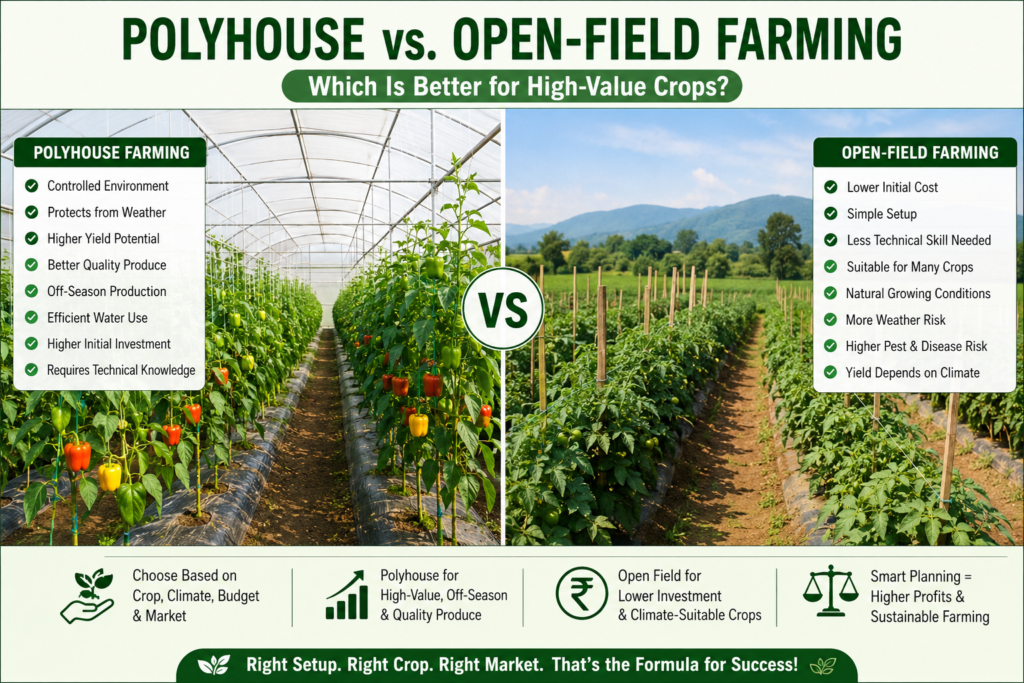
A polyhouse gives you greater control over the growing environment, while open-field farming is simpler and usually requires much less initial investment.
So, let’s compare the two and see which setup makes more sense for high-value crops. Polyhouse or Open-field
What Is Polyhouse Farming?
A polyhouse is a type of protected cultivation structure covered with a suitable plastic material. It creates a more controlled environment around the plants by reducing the impact of rain, wind, extreme temperatures and some pests.
Depending on the design, farmers can manage factors such as irrigation, humidity, ventilation and temperature more carefully.
Protected cultivation is particularly useful for high-value vegetables because it can support better crop quality, efficient resource use and off-season production. ICAR research and extension material identify crops such as capsicum, tomato, cucumber and other high-value vegetables as suitable candidates for protected cultivation.
In simple words, a polyhouse is like giving your crops a protective roof and a more manageable growing environment.
What Is Open-Field Farming?
Open-field farming is the traditional method most people are familiar with.
Seeds or seedlings are planted directly in prepared soil, and the crop grows under natural sunlight and weather conditions.There is no large protective structure around the crop.
This makes open-field farming comparatively straightforward and affordable. However, farmers have less control over heavy rain, strong winds, temperature fluctuations, pests and other environmental stresses.
For many crops, though, open-field farming remains an excellent option—especially when the crop is well suited to the local climate.
Polyhouse vs. OPEN-FIELD: AT a Glance
1. Investment: Open Field Wins
Let’s talk about money first.A polyhouse requires investment in the structure, covering material, irrigation, fertilisation, beds, equipment and regular maintenance. Depending on the level of technology, costs can vary considerably.
Open-field farming doesn’t require this type of infrastructure.
You still need expenses for seeds, soil preparation, irrigation, fertilizers, labour and crop protection, but the initial investment is generally much lower.
A study of capsicum cultivation in Punjab found that polyhouse production involved substantially higher establishment and production costs than open-field cultivation, although protected cultivation also produced considerably higher yields.
Winner for lower starting cost: Open field
2. Climate Protection: Polyhouse Has the Edge
Weather can be a farmer’s best friend—or worst enemy.
A sudden heavy rainfall, heatwave, cold spell or strong wind can damage a sensitive crop.
A polyhouse provides a physical barrier that can reduce exposure to some of these problems.
This doesn’t mean that polyhouse crops are completely protected. Poor ventilation, excessive humidity, extreme heat or inadequate management can create their own problems.
Still, protected cultivation gives farmers much more control than growing completely outdoors.
Winner: Polyhouse
3. Crop Yield: Polyhouse Can Have an Advantage
One of the biggest reasons farmers consider protected cultivation is productivity.
When crops receive suitable temperature, moisture, nutrition and growing conditions, they can potentially produce more marketable produce from the same area.
ICAR reports that protected cultivation can provide significant yield improvements for certain vegetable crops compared with traditional cultivation, although actual results depend on crop, variety, climate and management.
For example, an ICAR field demonstration in Mizoram reported substantially higher tomato production under protected conditions compared with open-field cultivation under the local conditions studied.
But remember:
A polyhouse does not automatically mean higher profits.Good management is what makes the difference.
Winner: Polyhouse, when properly managed
4. Water Management: Polyhouse Can Be More Efficient
Water is becoming increasingly important for modern agriculture.
In a polyhouse, drip irrigation and fertilisation can deliver water and nutrients closer to the plant roots.Because the crop is protected from direct rainfall and evaporation conditions can be managed better, water application can be more controlled.
ICRISAT notes that protected cultivation combined with drip irrigation and fertilisation can improve water and fertilizer-use efficiency.
Open-field farming can also be highly water-efficient when drip irrigation and mulching are used, so the difference isn’t simply “polyhouse good, open field bad.
“The irrigation system matters enormously.
Winner: Polyhouse, particularly with well-designed drip irrigation
5. Pest and Disease Management
Here’s where things get interesting.
A polyhouse can reduce exposure to certain pests and weather-related disease problems, particularly when insect-proof netting, sanitation and proper crop management are used.
However, pests don’t magically disappear inside a polyhouse.
In fact, if an infestation enters a protected structure, it can spread quickly because the environment may be favourable for the pest.
Open-field crops are naturally exposed to insects, rain and other environmental factors.
So the real lesson is:Protected cultivation reduces some risks but requires better monitoring.
Regular scouting, sanitation, ventilation and integrated pest management remain important.
Winner: Polyhouse—with good management
6. Off-Season Production: A Major Polyhouse Advantage
This is one of the strongest reasons to consider protected cultivation.
Normally, farmers grow crops when weather conditions are naturally suitable.
But markets don’t always pay the best prices during peak production.
If a polyhouse allows you to produce during a period when supply is lower, you may have an opportunity to reach better prices.
ICAR has highlighted off-season production as one of the major advantages of protected cultivation.
However, there is an important warning:
Never assume that off-season automatically means high profit.
Prices change according to supply, demand, transportation and local market conditions.Before planting, check who will buy your crop and what prices are realistically achievable.
Winner: Polyhouse
7. Which Crops Suit a Polyhouse?
Not every crop deserves the expense of a polyhouse.
The economics make more sense when you are growing crops that can command a good price or provide higher returns per unit area.
Common examples include:
- Coloured capsicum
- English cucumber
- Cherry tomatoes
- Hybrid tomatoes
- Specialty vegetables
- Selected herbs
- Lettuce and leafy vegetables
- Flowers such as gerbera and carnation
Government horticulture information also lists capsicum, English cucumber, hybrid tomato, gerbera, carnation and roses among crops commonly grown under polyhouse conditions.
Your local climate and market should determine the final crop choice.
8. Open Field Is Still a Very Good Choice
It’s easy to get carried away by the idea of modern farming.
A polyhouse looks impressive, and the possibility of higher yields sounds attractive.
But open-field farming should not be dismissed.
If your crop grows well in your local climate, your land is suitable, water is available and you have a reliable market, open-field farming may offer a much simpler business model.
For farmers starting with limited capital, it can also be a sensible way to gain experience before investing in protected cultivation.
9. The Hidden Cost of Polyhouse FarmingThere’s something many beginners don’t think about.A
- There’s something many beginners don’t think about.
- A polyhouse needs management.
- You may need to understand:
- Temperature management
- Ventilation
- Drip irrigation
- Fertigation
- Pruning and training
- Pest monitoring
- Disease prevention
- Crop scheduling
- Harvesting
- Post-harvest handling
- Market planning
- You also need to maintain the structure and replace damaged materials when necessary.
So don’t think of a polyhouse as:
“Build it and the crops will grow.”
It is closer to running a small agricultural production system.
10. Market Comes Before the Polyhouse
This might be the most important advice in this entire article.
Don’t build a polyhouse first and then ask where you’ll sell the crop.
Do the opposite.
First identify:
1.What crop will you grow?
2.Who will buy it?
3.What quantity can they purchase?
4.What quality do they expect?
5.What price range is realistic?
6.How far is the market?
7.What will transportation cost?
8.What happens if prices suddenly fall?
Protected cultivation can produce high-quality crops, but high production without a reliable market can quickly become a problem.
Research on protected cultivation in India has also identified market linkages, price volatility, technical knowledge and high upfront investment among important challenges.
Which Is Better?
What About a Combination of Both?
This may actually be the smartest approach for some farmers.
Instead of putting your entire farm into a polyhouse, you could maintain an open-field area while starting with a smaller protected cultivation unit.
For example:
Open field: seasonal vegetables and crops suited to your climate.
Polyhouse: coloured capsicum, cherry tomatoes, cucumber or another carefully selected high-value crop.
This approach allows you to diversify your production and learn protected cultivation without putting the entire farm investment into one system.
Final Thoughts
Polyhouse farming is not simply “better farming.”It is more controlled farming—but also more investment and more management.
Open-field farming is simpler and less expensive to start, but you have to accept greater exposure to weather and environmental conditions.
For high-value crops, a well-managed polyhouse can provide advantages such as better crop protection, improved resource management, higher productivity and opportunities for off-season production.
But profitability ultimately comes down to a combination of crop selection + production cost + yield + quality + market price + good management.
So before spending money on a polyhouse, do your homework.
The best farming setup isn’t necessarily the most modern one. It’s the one that fits your crop, climate, budget and market.
External Link—Vegetable Cultivation: Polyhouse vs Open Field
Frequently Asked Questions
1. Is polyhouse farming better than open-field farming?
Not always. Polyhouse farming offers greater environmental control and can be useful for high-value crops, while open-field farming requires less initial investment and may be better suited to crops that naturally perform well outdoors.
2. Which crops are suitable for polyhouse farming?
Common examples include coloured capsicum, English cucumber, hybrid tomatoes, cherry tomatoes and certain flowers and specialty vegetables. Crop suitability depends on climate, structure and market demand.
3.Is polyhouse farming profitable?
It can be profitable, but profitability depends on crop selection, investment, production costs, yield, selling price and market access. High initial investment and weak market linkages can create challenges.
4. Does polyhouse farming use less water?
A properly designed polyhouse using drip irrigation and fertilisation can improve water-use efficiency. However, good irrigation practices can also make open-field farming highly efficient.
5. Can vegetables be grown throughout the year in a polyhouse?
Protected cultivation can extend the growing season and make off-season production possible for suitable crops. However, the actual growing calendar depends on the crop, local climate and type of polyhouse.
6. Is polyhouse farming suitable for beginners?
It can be, but beginners should start carefully. Learning crop management, irrigation, fertilisation, pest monitoring and marketing before making a large investment is advisable.
7. Which is cheaper: polyhouse or open-field farming?
Open-field farming generally requires much less initial infrastructure investment. Polyhouse farming has higher establishment and operating requirements, although it may offer higher returns under suitable conditions.
8. What is the biggest advantage of polyhouse farming?
For high-value crops, one of the biggest advantages is the ability to create a more favourable growing environment and potentially produce higher-quality crops during periods when outdoor conditions are less suitable.