
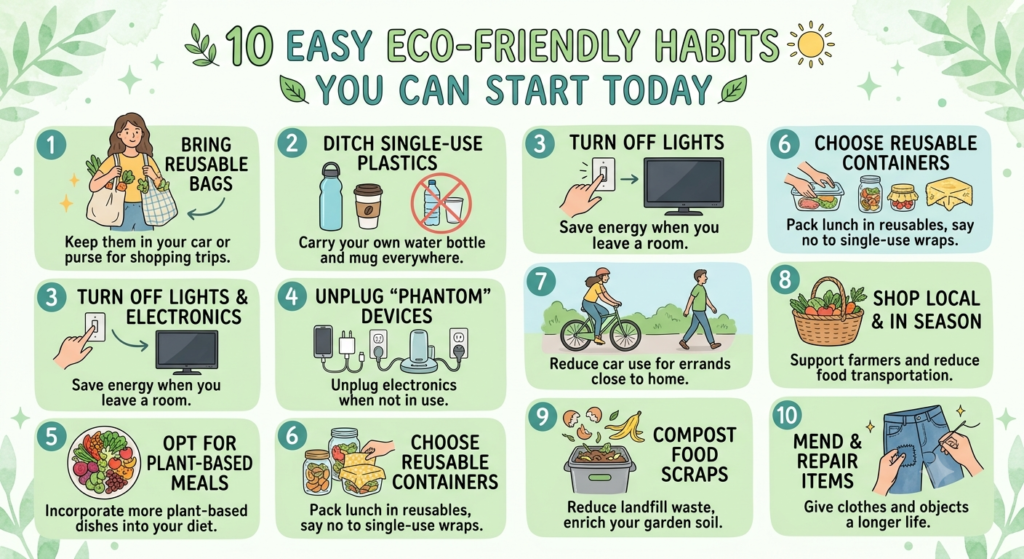
Living an eco-friendly life may sound like a big commitment. You might imagine solar panels, electric cars, compost bins and a completely plastic-free home.But here is the good news: you don’t have to change your entire lifestyle overnight.
Some of the best things we can do for the planet are surprisingly simple. Turning off an unnecessary light, carrying a reusable shopping bag or using leftover food creatively may seem like small actions, but when thousands of people do them regularly, they can make a meaningful difference.
The secret is to start small and stay consistent.If you are wondering how to make your daily routine a little greener without making life complicated, here are 10 easy eco-friendly habits you can start today.
Carry a Reusable Shopping Bag
One of the easiest changes is also one of the most practical.
Keep a couple of reusable cloth or jute bags near your front door, in your handbag or in your car. That way, you are less likely to accept a new plastic bag every time you shop.
This is particularly useful in India, where we often make quick trips to the local vegetable shop, grocery store or market.
Small habit: Keep a reusable bag where you can easily see it before leaving home.
Say Goodbye to Single-Use Water Bottles
If you regularly buy bottled water when you are out, consider carrying your own reusable bottle.
A stainless-steel or durable reusable bottle can become part of your everyday routine. Fill it before leaving home and take it along to work, while travelling or when going for a walk.
Apart from reducing plastic waste, it can also save money over time.
Small habit: Make your reusable bottle part of your daily essentials, just like your phone and keys.
Switch Off Lights and Appliances When Not Needed
We have all done it—walked out of a room and left the fan or light running.
Try making a habit of checking the room before you leave. Switch off lights, fans and other appliances when they are not needed.
You can also unplug chargers and devices that don’t need to remain connected.
Easy reminder: Whenever you leave a room, ask yourself, “Do I really need this switched on?”
Save Water During Everyday Tasks
Water is precious, yet it is surprisingly easy to waste it.
Turn off the tap while brushing your teeth, avoid letting water run unnecessarily while washing dishes, and repair leaking taps when you notice them.
When washing vegetables, you can also collect the water and use it for suitable household plants.
These little changes can turn water conservation into an everyday habit rather than a once-in-a-while effort.
Make the Most of Leftover Food
Food waste is another area where small changes can have a big impact.
Before throwing away leftovers, think about whether they can become tomorrow’s lunch or be turned into another meal.
For example, leftover cooked vegetables can sometimes become a filling for sandwiches or wraps, while extra rice can be used in a simple fried-rice-style dish.
And don’t forget about vegetable scraps that are suitable for composting.
The golden rule: Before throwing food away, ask, “Can I use this in another way?”
Grow Something at Home
Start with something simple such as mint, coriander, curry leaves, basil or chillies in pots on a balcony, windowsill or small terrace.
Growing even a few herbs can help you reconnect with nature. There is also something wonderfully satisfying about stepping outside and picking fresh coriander for dinner.
For beginners, start with just one or two plants rather than turning your home into a jungle overnight!
Choose Reusable Items Over Disposable Ones
Look around your kitchen and notice how many disposable products you use regularly.
Where practical, replace single-use items with reusable alternatives. Reusable food containers, cloth napkins, steel cutlery and washable cleaning cloths are simple examples.
You don’t need to throw away everything you already own. Use what you have until it needs replacing, then consider a reusable alternative.
READ MORE _https://greenharvestguide.in/essential-guide-to-sustainable-living-green-harvest-guide/
That is often the more sustainable approach.
Walk, Cycle or Share a Ride When Possible
For short journeys, consider walking or cycling if it is safe and practical.
For longer trips, car pooling or using public transport can reduce the number of individual vehicles on the road.
You don’t have to stop using your car completely. Even choosing a greener option once or twice a week can become a positive change.
And there is another bonus: walking and cycling can add a little more movement to your day.
Separate Your Household Waste
Recycling and responsible waste disposal begin at home.
Keep different types of waste separate according to the collection and recycling systems available in your area.
In many Indian households, separating wet/organic waste from dry waste is a useful starting point.
Food scraps and other suitable organic material can potentially be composted, while clean recyclable materials can be kept separate for appropriate collection.
Start simple: First create two clearly labelled waste containers, then improve your system as you become comfortable with it.
Buy Less and Choose Wisely
- Perhaps the most powerful eco-friendly habit is also the simplest:
- Buy only what you actually need.
- Before making a purchase, pause for a moment and ask:
- Do I really need this?
- Will I use it regularly?
- Can I repair something I already own?
- Is there a durable alternative?
- Can I buy it with less packaging?
- Buying fewer unnecessary things can reduce waste, save money and make your home less cluttered.
- Sometimes, the greenest purchase is the one we decide not to make.
You don’t need a huge garden to enjoy a greener lifestyle.
You Don’t Have to Be Perfect
Sustainable living isn’t about becoming perfect
.
There will be days when you forget your shopping bag, order something with extra packaging or leave the lights on. That’s normal.
The goal isn’t perfection. It’s progress.
Choose two or three habits from this list and practise them until they become automatic. Then add another.
Imagine if every household made just a few small changes.
Those individual actions could add up to something much bigger
A Simple Eco-Friendly Challenge
Why not make today your starting point?
For the next seven days:
Day 1: Carry a reusable shopping bag.
Day 2: Avoid buying a single-use plastic bottle.
Day 3: Check every room before switching off the lights and fans.
Day
Day 4: Save water while brushing and washing.
Day 5: Use leftovers creatively.
Day 6: Plant a herb or vegetable in a pot.
Day 7: Avoid one unnecessary purchase.
At the end of the week, you may be surprised by how naturally these habits fit into your routine.
External article-READ MORE–
10 Easy Eco Friendly Habits To Begin Today – Vitan Earth10 Easy Eco Friendly Habits To Begin Today – Vitan Earth
Final Thoughts
An eco-friendly lifestyle doesn’t need to be expensive, complicated or overwhelming.
It can begin with something as ordinary as switching off a light, carrying a cloth bag, saving a little water or growing mint in a pot.The important thing is to begin.
At GreenHarvest Guide, we believe sustainable living should be practical, enjoyable and achievable for everyday households. You don’t need to change everything at once. Just make one greener choice today—and another tomorrow.
Small habits can grow into a greener way of life.
Frequently Asked Questions
1.How an I live more sustainably at home?
You can start by reducing household waste, separating waste appropriately, saving water and electricity, using reusable products and growing herbs or vegetables at home.
2.What are the easiest eco-friendly habits to start with?
Start with simple habits such as carrying reusable bags and bottles, saving water and electricity, reducing food waste and avoiding unnecessary purchases.
Can eco-friendly habits save money?
3.Can eco-friendly habits save money?
Yes. Habits such as using reusable products, reducing food waste, saving electricity and buying only what you need can help reduce everyday expenses.
4.Do small eco-friendly actions really make a difference?
Yes. Individual actions may seem small, but when they become consistent habits across many households, their combined effect can be significant.
5.What is the most important eco-friendly habit?
There isn’t one single habit that is best for everyone. A good starting point is to reduce unnecessary consumption and waste while using resources such as water and energy thoughtfully.
6. How can beginners start sustainable living?
How can beginners start sustainable living?Don’t try to change everything at once. Pick two or three easy habits, make them part of your routine, and gradually introduce more sustainable choices.