
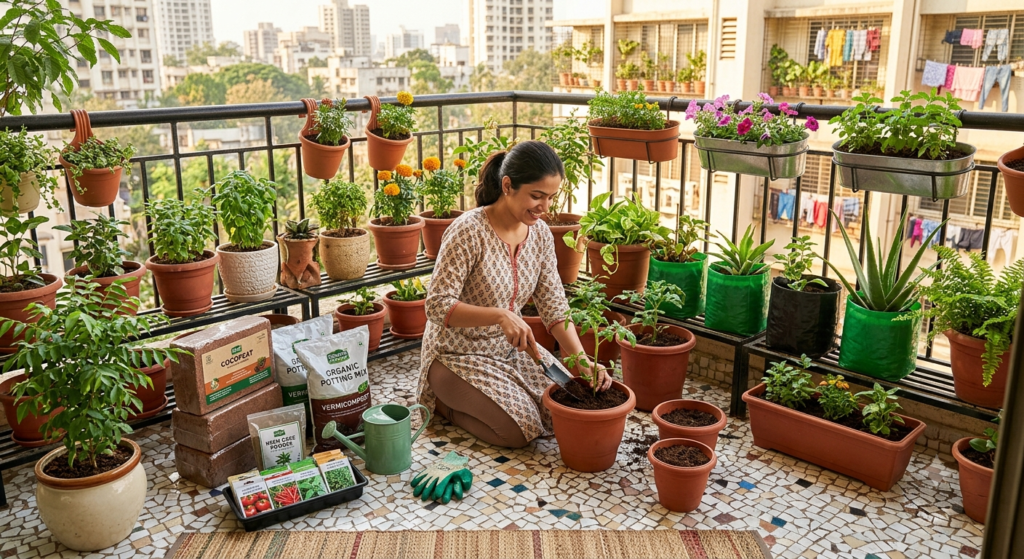
Buying Guide for Potting Mixes, Seeds, and Balcony Planter Setups in India
So, you’re staring at your balcony, sipping your morning chai, and thinking: “I could totally turn this concrete nook into a lush, green jungle.”
We’ve all been there. But then reality hits—unforgiving Indian summers, monsoon downpours, concrete load-bearing limits, and those mysterious red soil bags from the local nursery-wale bhaiya that turn into brick hard clay after two waterings.
Setting up a balcony garden in an Indian apartment isn’t just about buying pretty pots; it’s about smart engineering in small spaces. Whether you want a continuous supply of homegrown dhaniya-mirchi or a relaxing sanctuary of leafy greens, here is your definitive, no-nonsense buyer’s guide to picking the right potting mix, seeds, and containers.Here is- The Ultimate Buyer’s Guide for Balcony Gardening in India
What Should You Buy First for a Balcony Garden?
Before opening an online shopping app or visiting a nursery, decide what you actually want to grow.
A beginner’s basic shopping list can be surprisingly short:
- Good-quality potting mix
- Seeds or healthy seedlings
- Suitable pots or grow bags
- Compost or vermicompost
- A watering can or bottle
- Drainage trays where necessary
- Plant labels
- Simple support sticks for climbing plants
You can add gardening tools and specialised products later.
The biggest beginner mistake is buying supplies first and deciding what to grow afterwards. Choose your plants first, then buy the containers and growing medium around their needs.
1. How to Choose the Right Potting Mix
The growing medium is one of the most important purchases for container gardening.
Garden soil taken directly from the ground can become compacted inside a pot and may not provide the drainage and aeration that container-grown plants need.
A good potting mix should generally be light, reasonably moisture-retentive, well-aerated and capable of draining excess water.
When shopping, don’t judge a product only by the words “organic” or “premium” printed on the packet.
Instead, look at the ingredients.
Cocopeat
Cocopeat, or coco coir, is made from coconut fibre and is widely used in container gardening.
It is lightweight and helps the growing medium retain moisture without making the container as heavy as ordinary soil.
Look for:
- Clean, relatively fine material
- Low-salt or washed cocopeat
- Good moisture retention
- A reputable seller
Cocopeat is particularly useful when creating your own potting mix.
Vermicompost
Vermicompost is compost produced with the help of earthworms. It is commonly used as an organic source of nutrients and can help improve growing-medium structure.
When buying it, look for a product that:
- Looks dark and crumbly
- Does not have a strong rotten smell
- Is free from obvious plastic or other contaminants
- Comes from a reliable supplier
Remember that vermicompost is an amendment or nutrient source; it isn’t necessarily a complete replacement for every component of a potting mix.
Perlite
Perlite is a lightweight mineral material used to improve aeration and drainage.
It can be particularly useful if your balcony receives frequent rain or if you tend to overwater.
A small packet may be enough when you’re just starting.
Organic Add-ins:
Add a handful of Neem Cake Powder (to keep root-eating pests away) and Bone Meal / Mustard Cake (for root strength and blooming) per pot.
Ready-Made Potting Mix
If mixing ingredients sounds like too much work, a ready-made potting mix can be convenient.
For example, current Indian shopping results include ready-to-use mixes containing combinations of cocopeat, organic manure, per-lite and other ingredients.
The important thing is to read the ingredient list rather than buying based solely on the brand name.
Lazy Buyer’s Hack: If mixing your own sounds like high school chemistry, buy pre-packaged Ready-to-Use Organic Potting Mix from trusted brands like TrustBasket, Bombay Greens, or Ugaoo. Just verify that “Cocopeat-based” is listed as the primary ingredient!
2. How to Buy Seeds for Your Balcony Garden
Not all seeds are created equal. Buying cheap, unbranded seed packets off the street often results in low germination rates or weak plants.
Check the Seed Packet Carefully
Before buying, look for:
- Crop or variety name
- Seed quantity
- Packing date
- Germination information where provided
- Recommended growing season
- Expiry or use-before information where applicable
- Seller/manufacturer details
- Instructions for sowing
Prefer seeds from established sellers and avoid packets that appear damaged, damp or poorly stored.
Buy Seeds According to Your Space
First ask:
“Can I actually grow this plant in my available space?”
For example:
Depending on season and sunlight, consider:
- Coriander
- Fenugreek (methi)
- Spinach
- Radish
- Green chilli
- Tomato
- Lettuce
- Basil
- Mint from cuttings or nursery plants
The exact choice should depend on your local climate and the amount of sunlight available.
Recent Indian balcony-gardening guidance also highlights crops such as mint, green chilli, tomato and coriander as possibilities for small kitchen gardens.
Don’t Forget Plant Size
A tiny seed can eventually become a surprisingly large plant.
Tomatoes, chillies, brinjal, okra and climbing vegetables can need considerably more space than leafy greens.
So check:Seed → mature plant → container size → sunlight → supportbefore buying.
3. Hybrid, Open-Pollinated or “Organic” Seeds?
Hybrid Seeds
Hybrid varieties are developed by crossing selected parent plants. They can offer particular characteristics such as uniformity, vigour or specific fruit qualities.
Open-Pollinated Seeds
Open-pollinated varieties are pollinated naturally or through controlled pollination and can be useful for gardeners interested in saving seed, provided the variety and growing conditions are suitable.
“Organic Seeds”
The word “organic” should not automatically mean “better for every balcony garden.
”If organic certification matters to you, check what certification or standard the seller is actually referring to rather than relying only on marketing language.
For beginners, variety suitability, freshness, seller reliability and growing requirements are often more useful buying considerations.
4. Choosing Balcony Planters: Pots vs Grow Bags
Now comes the fun part—the containers!
There are several options available in India.
Plastic Pots
Plastic pots are:
- Lightweight
- Affordable
- Easy to move
- Available in many sizes
They can be a practical choice for balconies where weight is a concern.
Choose sturdy containers with proper drainage holes.
Terracotta Pots
Terracotta looks beautiful and has a traditional gardening feel.
However, it is heavier and can dry out faster than some plastic containers.
They’re excellent for gardeners who enjoy the natural appearance and don’t need to move their pots frequently.
Grow Bags
Grow bags are popular for vegetables because they are lightweight and available in many sizes.
They can work particularly well for crops such as tomatoes, chillies and other vegetables that need more root space.
Railing Planters
Railing planters make use of otherwise unused vertical or edge space.
For example, current Indian shopping options include railing planters designed to hang from balcony railings.
But don’t simply hang a heavy planter on a railing and forget about it.
Always check that the planter is securely attached and that the balcony railing can safely support the setup
.
6. Drainage Is More Important Than Fancy Pots
A beautiful pot is useless if excess water has nowhere to go.
Before buying a planter, check:
Does it have drainage holes?
This simple question can prevent many problems.
Waterlogged growing media can reduce oxygen around roots and contribute to root problems.
Place a suitable tray underneath indoor or balcony containers where necessary, but don’t allow pots to sit permanently in standing water.
And don’t assume that adding a thick layer of gravel automatically solves poor drainage. The overall structure of the growing medium and the pot’s drainage design matter more.
7. How Much Sunlight Does Your Balcony Get?
Before buying seeds or plants, spend one day observing your balcony.
Is It depends on what you grow.
Fruiting plants like tomatoes, chillies, and brinjal need 5 to 6 hours of direct sunlight.
Leafy greens like spinach, mint, and lettuce can easily thrive on 3 to 4 hours of bright, indirect sunlight.
This information can completely change what you should buy.
A sunny balcony can support many vegetables and flowering plants.
A shaded balcony may be better suited to plants that tolerate lower light.
Don’t buy a plant that needs six hours of strong sunlight if your balcony receives only an hour or two.
8. Build a Simple Balcony Garden Setup
You don’t need 20 pots on day one.
Try this instead:
- 2 medium pots for herbs
- 2 larger containers for vegetables
- 1 wide container for leafy greens
- Quality potting mix
- 3–5 seed varieties
- One watering can
- A few labels
This might be the most useful advice in this entire guide.
Your first balcony garden doesn’t need to look like a nursery.
Start small.
Buy enough supplies for five or six plants, learn how often your balcony dries out, observe sunlight and understand your watering routine.
Then expand.
A small garden that you can maintain is much better than a huge collection of pots that becomes difficult to manage.And honestly, there’s something wonderful about watching your first coriander seedlings appear after you’ve carefully prepared the soil.
The first harvest may be tiny—but the satisfaction certainly isn’t.
External Link-READ MORE-“10 Powerful Balcony Gardening Tips to Grow More in Small Spaces (2026)”
INTERNAL LINK-/READ MORE-“7 Easy Vegetables to Grow at Home for Beginners”
The Ultimate Buyer’s Guide for Balcony Gardening in India-Final Thoughts
The secret is to buy according to your plants rather than buying according to advertisements.
Choose suitable seeds, use a quality growing medium, select containers with enough root space and drainage, and consider your balcony’s sunlight before spending money.
Start with a few easy plants. Learn from them. Then slowly build your little green corner.
Whether you’re growing coriander in a shallow container, tomatoes in a large grow bag or herbs along a sunny railing, the right buying decisions can make balcony gardening much easier—and a lot more enjoyable.
Frequently Asked Questions
1. What is the best potting mix for balcony plants in India?
A good balcony potting mix should be lightweight, well-aerated, moisture-retentive and well-draining. A combination of cocopeat/coir, compost or vermicompost and an aeration material such as per-lite is commonly used. The ideal mix depends on the plant and local conditions.
2. Can I use garden soil in balcony pots?
Garden soil can become compacted and heavy in containers. For most balcony gardening, a properly prepared container mix is preferable. If garden soil is used, it is generally better incorporated as one component rather than relying on it alone.
3. Which seeds are easiest for balcony gardening in India?
Coriander, methi, leafy greens, radish and some herbs can be good starting points. Tomatoes and chillies are also popular, although they require more space and care as they mature.
4. Are grow bags better than plastic pots?
Neither is automatically better. Grow bags are lightweight and useful for many vegetables, while plastic pots are easy to move and available in many shapes and sizes. Choose based on the plant, available space, weight and drainage.
5. How do I choose a planter size?
Choose the container according to the mature plant’s root requirements, not the size of the seedling. Larger fruiting vegetables generally need larger containers than herbs and leafy greens.
6. Are railing planters safe for balconies?
They can be useful, but they should be securely fitted and not overloaded. Remember that a planter becomes considerably heavier after adding growing medium and water. Check the condition and suitability of your railing before installation.
7. Should beginners buy ready-made potting mix?
Yes. Ready-made potting mix can be a convenient option for beginners who don’t want to measure and mix individual ingredients. Read the ingredient list and choose a product appropriate for the plants you intend to grow.
8. How many plants should I start with?
For a first balcony garden, around five or six plants is a manageable starting point. Once you understand your balcony’s sunlight, watering needs and available space, you can gradually add more.
9.Can I grow vegetables on a small balcony?
Yes. Many vegetables and herbs can be grown in containers if you choose varieties and containers appropriate for the available space. Sunlight, container depth and regular care are more important than having a large garden.